

THE RHEINISCHES REVIER IS A REGION IN TRANSITION AND UNDERGOING CHANGE.
On the one hand, it remains the largest lignite mining area in Europe to this day. In the three open-pit mines of Garzweiler, Hambach, and Inden, approximately 60 million tons of lignite are extracted annually from depths of up to 400 meters. For many decades, the region has been shaped by the extraction and processing of lignite, primarily for electricity generation.
On the other hand, the Rheinisches Revier is undergoing a massive structural transformation. In 2019, the Coal Commission decided that Germany would phase out lignite-fired power generation by 2038. In 2021, the state government of North Rhine-Westphalia first defined the spatial framework for the coal phase-out and also brought forward the phase-out of lignite mining to 2030. The state government of North Rhine-Westphalia is using this accelerated coal phase-out as an opportunity to develop the Rheinisches Revier into the most modern and climate-friendly energy and resource region in Europe.
Where open-pit lignite mines currently dominate the landscape, vast lake districts offering recreational and leisure activities are set to emerge in the coming decades. Yet the profound structural transformation in the Rheinisches Revier extends far beyond the landscape itself. Alongside new natural landscapes, innovative residential and commercial areas are being developed for companies looking to establish themselves in the region. In this way, the Rheinisches Revier can become a magnet for people and companies seeking to grow in a forward-looking, sustainable, and livable environment.
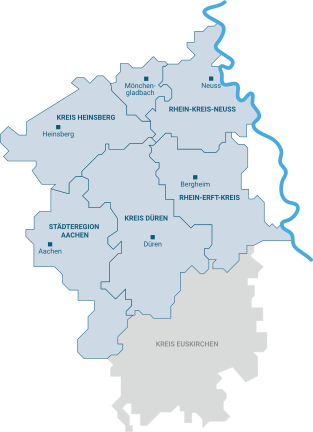
THE RHEINISCHES REVIER COMPRISES THE DISTRICTS OF …
… Düren, Heinsberg, the Rhein-Erft district, the Rhein-Kreis Neuss, as well as the Aachen urban region and the city of Mönchengladbach. Approximately 2.4 million people live in the region’s 65 cities and municipalities. The region covers an area of just under 5,000 km². In close proximity to the Rheinisches Revier lie the economically strong metropolitan areas of Cologne and Düsseldorf, as well as the Benelux countries. Highways, well-developed rail and waterway networks, and the international airports in Düsseldorf and Cologne/Bonn ensure excellent connectivity for the region.
These factors make the Rheinisches Revier a desirable place to live for international professionals and an attractive location for globally active companies. It offers excellent conditions for residents, businesses, and international professionals to work together to shape the Rheinisches Revier into a sustainable and modern region of the future in the heart of Europe.
The sponsors of the Welcome Center KMU – Rheinisches Revier, with the support of the State of North Rhine-Westphalia and numerous partners, act as a network dedicated to the region and its people. Ensuring that integration and regional transformation succeed in equal measure.
Sources:
www.bund-nrw.de/themen/braunkohle/hintergruende-und-publikationen/braunkohlentagebaue/
www.umwelt.nrw.de/themen/umwelt/transformative-strukturpolitik/rheinisches-revier
www.rheinisches-revier.de/rheinisches-revier/ueber-das-rheinische-revier
www.umwelt.nrw.de/themen/umwelt/transformative-strukturpolitik/rheinisches-revier